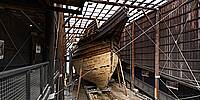

Replicating the San Juan
Pasai San Pedro, Gipuzkoa, Basque Country, Spain
July 29, 2025, 18:20hs, local time
© 2025 Iñaki Rezola, All Rights Reserved.
This picture was taken on July the 29th. The nao San Juan was launched in November, for the putting up of the masts and sails could not be made inside the Albaola factory. As of spring of 2026 it will be open to visitors. The selection of the crew will take place during the summer and then will begin their training. And a year later, it will set sail for Canada. A perfect replica of a XVIth century ship that will replicate also the navigation of that time, including the crew’s daily life: they will be using the same sailing instruments, wearing identical clothing, eating and drinking the same food and drinks and having the same facilities of that time. Without modern technology involved in the navigation nor motorisation from a propulsion point of view, it will be an effort to discover what the navigation at the time was like. A kind of ‘archaio-navigational’ experiment. This emphasis on authenticity is what led to its UNESCO sponsorship.
The ship and the expedition will culminate a huge collective effort that started when a man -Xabier Agote- reading a National Geographic article about the founding of the wreck of a XVIth century Basque transoceanic ship designed for whaling, the San Juan, sunken in 1565 in Newfoundland, Canada, decided to bring the ship back to life.
The San Juan was found in 1978, ten meters down the icy waters near the town of Red Bay, Labrador, by underwater archaeologists from the Parcs Canada agency under the guide of Robert Grenier following the suggestions of researcher Selma Huxley, who was aware by toponyms, documents, and oral traditions of the presence of European whalers in the area and had subsequently made research in Spanish archives. The wood of the ship had been so well preserved that during six years each piece of its structure, along with cargo and personal belongins of the sailors, could be thoroughly recorded. The amount of information was such that it took almost 30 years to complete their study, making it the best known cargo ship of the XVIth century. After finishing the underwater archaeological work the wreck was left on the seabed, monitored and protected. The San Juan is now part of the UNESCO Underwater Cultural Heritage logo, and the whole site a World Heritage one.
Albaola Itsas Kultur Faktoria was founded by Xabier Agote to build the exact replica of the San Juan after agreements with Canada Parks to develop accurate plans of the ship based on the archaeological data -their thorough study took almost 30 years!- in order to construct its faithfull replica in Pasaia-Pasajes, where the original San Juan was once built. The same materials and construction techniques of the time would be used.
Bringing back to life skills that had almost died out and forming the people to work on it were, according to Agote, the greatest difficulty in developing the project. It involved a lot of research and formation. That is why the whole process of the construction of the San Juan will have taken almost 13 years. All the elements on it will have been made with the same materials and procedures they were made in the XVIth century: wooden elementes (like the ship itself, the barrels for food and drink, the whaling small boats), metallic (nails, iron fittings, guns, harpoons, ancors, cooking casseroles, copper cauldrons for oiling the whale blubber), textile (clothing, sails, ropes), raw materials (tar and pitch), etc. Everything will be a perfect replica of what was on the San Juan when it sailed the seas. The ship is now awaiting the addition of its masts and sails.
Agote himself will be in charge of the expedition and the archaeological navigation. There will be a GPS to assist it but it will not take part in the navigation process itself, and maritime authoroties say that another ship will follow at a distance. The navigation is expected to be “an important process of science and learning”. The ship will be at the mercy of the wind and the skill of the crew. “What interests us is reliving the experience. We want to replicate everything because the replica is based on authenticity”. Which includes daily life on board. The crew -composed of around 40 professional and volonteer members who will need to be trained and will be wearing period clothing - will be divided into three groups and will work in shifts: the sleeping one, the resting one, and the working one, all of them collaborating at once if needed.
The food will be composed of the same products the Basques took with them in the XVIth century and prepared the same way. Cider was was the main drink of the Basques on the seas and oceans, as water spoils easily. Incidentally, cider, rich in vitamin C, spared them from diseases common among other sailors at the time. A chief is being looked for the trip.
And about hygiene?
There won't be a shower nor a toilet…! The ship has a latrine in the bow that empties into the sea. In those days, they used a piece of old rope fraid into a brush shape that was thrown overboard with their waste.
On arriving an ambitious cultural programme based on the heritage shared by Basques and Canadians will be rolled out. But no whale will suffer any harm this time around.
*
The archaeological data resulting from the San Juan, other wrecks, and findings of the same area of Red Bay are shown now in the museum “National historic Site of Red Bay”.
*
More pictures of Albaola and the nao San Juan (handheld shots), here.
And a résumé of some of my favourite panos of the year 2025.
Lat: 43° 19' 44.418" N
Long: 2° 56' 31.458" W
Precision is: Medium. Nearby, but not to the last decimal.
Nikon 8, 7Artisans 10mmII f2,8, shot handheld, NX Studio, PTGui Pro
 Tap or click the zoom icon in the bottom right corner of the picture to switch between in-page and fullscreen view