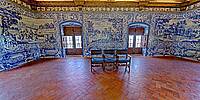

Sala dos Brasões - Coat of Arms Room
Sintra, Palácio Nacional de Sintra
May, 25th, 2025 – 14:10 WEST (UTC+01:00)

© 2026 Carsten T. Rees, All Rights Reserved.
The Palácio Nacional de Sintra – aka Town Palace – is the best-preserved royal residence of medieval times in Portugal. Its origins date back to the Moorish time in Al-Andalus. In the 12th century, Sintra was conquered by King Afonso Henriques. He took the palace as his own residence. The palace was altered over the centuries. This led to a unique blend of different styles: Moorish, Mudéjar, Gothic and Manueline. Most of the current buildings date back to the 15th century. The palace is a UNESCO World Heritage Site – one of so many impressive sites in Portugal.
In the panorama you can see the Sala dos Brasões (Coat of Arms Room). It was built in the 16th century. It was damaged in the 1755 Lisbon earthquake and subsequently restored. The azulejos (painted tin-glazed ceramic tilework) date from that time.
The following description is taken from https://www.sintraexplorers.com/post/a-room-fit-for-kings-the-sala-dos-bras%C3%B5es-at-sintra-palace:
“The first thing that captures your attention is the soaring octagonal dome that crowns the room. Adorned with an intricate and unique decor, it sets the stage for the historical narrative that unfolds within. At its heart, against a celestial blue backdrop, soars the royal coat of arms of King Manuel I, the monarch of the age. Surrounding it are eight shields, each representing one of his eight children.
King Manuel I, who had a total of thirteen children, was depicted in the room during a specific period when he had just eight offspring. This explains the eight shields, two of which are diamond-shaped to represent the infantas, D. Isabel and D. Beatriz. These shields, each a blend of paternal and marital lineage, had blank spaces when the ceiling was first adorned, signifying that these infantas were yet to marry. Notably, one of the shields stands apart - that of the infant and prince D. Yoam, distinguished by its singular design. In Portugal and Spain, only the designated heir to the throne carries the title of prince. As D. Yoam was the likely successor to D. Manuel I, his shield bore no additional family symbols, hence its unique character.
Beneath these royal emblems, a band of majestic stags, inscribed within octagons, encircles the room. These symbols represent the nobility of Portugal, as hunting was a shared pastime among the upper class. The stags bear 72 shields, each commemorating a prominent noble family from the reign of D. Manuel I, including those of Vasco da Gama and Pedro Álvares Cabral. Adorning the room, an inscription reads, "Pois com esforços leais serviços foram ganhados com estas e outras tais devem ser conservadas" – “For with loyal efforts, services were won, and these and other such things must be preserved.”- a testament to the king's gratitude towards these families for their support upon his ascension to the throne.”
The Palace of Sintra is now a museum. It is well worth visiting. The exhibition and the audio guide give you a perfect overview of Portuguese history. We stayed far longer than planned and enjoyed it very much.
Lat: 38° 47' 53.16" N
Long: 10° 24' 28.176" W
Precision is: High. Pinpoints the exact spot.
Canon EOS 5D MKIV, Canon EF 8-15mm, Nodal Ninja R1, DXO, Photomatix Pro 7, PTGui Pro, Photoshop 2025, Topaz Photo AI, Pano2VR
 Tap or click the zoom icon in the bottom right corner of the picture to switch between in-page and fullscreen view