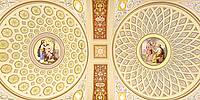

Gallery of the History of Ancient Painting
New Hermitage, Saint Petersburg, Russian Federation
January 15, 2026 - 14:00 GMT+0

© 2026 Andrew Varlamov, All Rights Reserved.
The Gallery of the History of Ancient Painting was conceived as the first hall entered by visitors to the New Hermitage after ascending the grand staircase to the first floor. According to the architect's design, the Gallery preceded the large, skylight-shaped halls designed for Flemish, Spanish and Italian painting. In creating the Gallery, Leo von Klenze drew on his early experience gained during the construction of the Munich Pinakothek, where he used subjects from the history of Italian and German painting to decorate the halls. For the Gallery in the New Hermitage, he decided to use subjects from the history of ancient Greek painting. Klenze wrote: «The historical evocation of an ancient era arouses interest, attracts and helps the viewer <…> to experience the spirit of a remote age.» «The spirit of time rules the life and art, and in our collections we will try to present these ideas as still alive.» The architect developed and put into practice the simple principle of influence, making such a strong impression upon visitors. In the architect’s opinion, the impact of the exhibits was increased many times over when they formed a single whole with the Neo-Grecian interior decoration. It was a palace museum, and he considered that rich decoration of the halls would aid aesthetic appreciation: luxurious decoration, the bright colours of the walls forming the background for the works of ancient art would attract attention and give pleasure to a visitor.
In his program of 86 subjects, Klenze allocated space both to individual works, "constituting an era or having become famous for some reason," and to individual stages in the development of ancient painting. Even completely abstract concepts were envisaged: the decline of painting, its Renaissance, the properties of the Attic school, and so on. Thus, the chariots of the Helios and Selena were intended to be "both symbols of the natural ability to luminosity, which constitutes the principle of all colors". Subjects such as "Milo of Croton" and "The Bath of Phryne" "symbolize the direction that art was now taking in depicting nature in graceful repose and in a state of supreme affect". The last two paintings of the cycle, "Chaos" and "Phoenix", "symbolize the subsequent era of barbarism and the rebirth of the arts."
Klenze's primary source for the program was the work of the Roman encyclopedist Pliny the Elder, "Natural History." Of the 86 stories, 51 come from Pliny, five are borrowed from the Greek writer Athenaeus, and Klenze took four stories each from the works of Strabo, Pausanias, and Lucian. The remaining authors are represented in his program by a single story: the Greek writers Plutarch, Aristophanes, Clement of Alexandria, and Dio Cassius, and the Roman writers Seneca, Suetonius, Vitruvius, Valerius Maximus, Velleius Paterculus, and Julius Capitolinus. One episode is borrowed from the Byzantine historian Eunapius.
Subjects from ancient literature were intended to represent the history of the development of Greek and Roman painting: its origins, the progressive refinement of technique and expressive means, the creation of schools, the distinctive features of individual artists, and the emergence of the genres of historical painting, allegorical, genre, landscape, and portraiture. Most interesting are Hiltensperger's recreations of lost masterpieces, such as Appeles's "Alexander the Thunderer", Timomachos's "Medea", or Zeuskis's "The Family of Centaurs". In these recreations, Cornelius's faithful disciple, who valued, above all, precision of drawing and clarity of narrative, skillfully departed from dispassionate illustrativeness and created paintings distinguished by a pathetic intensity of emotion and vibrant color effects.
Each painting in the room is framed by an ornamental motif borrowed from the decorative painting of Pompeii and Ancient Rome. All 86 paintings were intended to serve as the main color accents in this complex interweaving of grotesques, painted in muted tones.
Each painting has a Roman numeral enclosed in a cartouche. This corresponds to its description in Klenze's program. Sometimes the artist's Greek name or the title of their work is given in the cartouche beneath the painting.
Lat: 59° 56' 30.081" N
Long: 30° 19' 1.574" E
Precision is: Medium. Nearby, but not to the last decimal.
Camera: Pentax K-5 II; Lens: Samyang 8mm f/3.5 UMC Fish-eye CS II; Hot shoe two axis double bubble spirit level: ROWI 197;Cable switch: CS-205; Shooting without tripod manual by Nuno A. Madeira (Portugal); PC Software: PTGui Pro 10.0.19 by New House Internet Services B.V. (dated by June 6, 2018), Pano2VR 6.1.8 pro 64bit by Garden Gnome Software (dated by May 25, 2020)
- Hall 241 - The Gallery of the History of Ancient Painting
- Studying the European Visual Arts 1800-1850. Paintings, Sculpture, Interiors and Art on Paper. CATS Proceedings, III, 2016. ISBN 978-1-909492-52-3. Pages 134-144 contain article of Renate Poggendorf titled "In search of the ultimate painting technique: Munich in the 1820s–1840s"
- O.Neverov, Galereya istorii drevney zhivopisi, Saint Petersburg, 2002. (in Russian)
- A.Trofimova, The Programm of the rearrangement of galleries of Classical Antiquities in the State Hermitage Museum (2000-2019). Archeologia classica : rivista dell’Istituto di archeologia dell’Università di Roma.Vol. LXXI - n.s. II, 10 , Rome 2020, pp. 523-549
- Fedorov, S. G. (2003). Klenze und St. Petersburg - Bayern und Russland: Verzeichnis der Quellen mit einem Überblick über die Architektur- und Ingenieurbeziehungen 1800-1850. (Mitteilungen / Osteuropa-Institut München, Historische Abteilung, 51). München: Osteuropa-Institut München. https://nbn-resolving.org/urn:nbn:de:0168-ssoar-63259-5 (in German/Russian)
- Leo von Klenze - painting XXIX -
http://mediatum.ub.tum.de/?id=924275 . Architekturmuseum der Technischen Universität München - Leo von Klenze - parquet flooring - http://mediatum.ub.tum.de/?id=924130 . Architekturmuseum der Technischen Universität München
- Leo von Klenze - paintings XL-XLIII - http://mediatum.ub.tum.de/?id=924116 . Architekturmuseum der Technischen Universität München
- Leo von Klenze - paintings XIII-XV - http://mediatum.ub.tum.de/?id=924114 . Architekturmuseum der Technischen Universität München
I. (Tondo in the dome) The mythical Danaus brings painted wooden images of gods from Egypt to Greece - "The most famous building in the city of Argos is the sanctuary of Apollo Lycius (Wolf-god). The modern image was made by the Athenian Attalus, but the original temple and xoanon (wooden image) were the offering of Danaus. I am of opinion that in those days all images, especially Egyptian images, were made of wood." (Pausanias, Description of Greece, Book 2, Chapter 19,3)
II. A Greek artist decorates wooden images of gods with paintings. "An activity which, perhaps, should be considered as the very first beginning of life in Greece," added Klenze in his program.
III. Chariot of Helios - "As he rides in his chariot, he shines upon men and deathless gods, and piercingly he gazes with his eyes from his golden helmet. Bright rays beam dazzlingly from him, and his bright locks streaming from the temples of his head gracefully enclose his far-seen face" (Homer, Hymn XXXI (To Helios))
IV. Chariot of Selene - "From her immortal head a radiance is shown from heaven and embraces earth; and great is the beauty that ariseth from her shining light. The air, unlit before, glows with the light of her golden crown, and her rays beam clear, whensoever bright Selene having bathed her lovely body in the waters of Ocean, and donned her far-gleaming raiment,
and yoked her strong-necked, shining team, drives on her long-maned horses at full speed, at eventime in the mid-month: then her great orbit is full and then her beams shine brightest as she increases." (Homer, Hymn XXXII (To Selene))
V. The legend about the daughter of the Corinthian potter Butades.
Pliny gives this charming tale as an illustration of the first steps of plastic art: "It may be suitable to append to these remarks something about the plastic art. It was through the service of that same earth that modelling portraits from clay was first invented by Butades, a potter of Sicyon, at Corinth. He did this owing to his daughter, who was in love with a young man; and she, when he was going abroad, drew in outline on the wall the shadow of his face thrown by a lamp. Her father pressed clay on this and made a relief, which he hardened by exposure to fire with the rest of his pottery" (Pliny, Book XXXV, 151)
VI-IX. The paintings are dedicated to the improvements that ensured the rapid development of Greek painting in the 6th century BC.
VII. "Ecphantus of Corinth is said to have been the first to daub these drawings with a pigment made of powdered earthenware."(Pliny, Book XXXV, 16)
VIII. "Line-drawing was invented by the Egyptian Philocles or by the Corinthian Cleanthes, but it was first practised by the Corinthian Aridices and the Sicyonian Telephanes - these were at that stage not using any colour, yet already adding lines here and there to the interior of the outlines" (Pliny, Book XXXV, 16)
IX. Eumarus was the first to distinguish lighter-skinned women from darker-skinned men. - "...the painters in monochrome, whose date is not handed down to us, came considerably earlier - Hygiaenon, Dinias, Charmadas and Eumarus of Athens, the last being the earliest artist to distinguish the male from the female sex in painting, and venturing to reproduce every sort of figure" (Pliny, Book XXXV, 56)
X. "It was Cimon who first invented 'catagrapha,' that is, images in 'three-quarter,' and who varied the aspect of the Ardik was the first to notice details among such silhouettes.features, representing them as looking backward or upward or downward; he showed the attachments of the limbs, displayed the veins, and moreover introduced wrinkles and folds in the drapery." (Pliny, Book XXXV, 56)
XI. Running in a Gymnasium – artists depict athletes running. The source of this scene is unknown.
XII. Wrestling on the Palaestra. The source of this subject is also unclear. "These paintings point to sources from which Greek artists drew 'elements of refinement that henceforth accompanied the beauty and vitality of their treatment of form,'" wrote von Klenze.
XIII-XV. "In the temple of Artemis Alpheionia are very famous paintings by two Corinthians, Cleanthes and Aregon: by Cleanthes the 'Capture of Troy' and the 'Birth of Athene,' and by Aregon the 'Artemis Borne Aloft on a Griffin.' " (Strabo, Geography, Book VIII, Chapter 3, 343)
XVI. (Tondo in the dome) Cimon of Athens commissioned and exhibited for the first time a painting of historical subject matter in the Stoa Poikile -
"Battle of Marathon" - "At the end of the painting are those who fought at Marathon; the Boeotians of Plataea and the Attic contingent are coming to blows with the foreigners. In this place neither side has the better, but the center of the fighting shows the foreigners in flight and pushing one another into the morass, while at the end of the painting are the Phoenician ships, and the Greeks killing the foreigners who are scrambling into them. Here is also a portrait of the hero Marathon, after whom the plain is named, of Theseus represented as coming up from the underworld, of Athena and of Heracles. The Marathonians, according to their own account, were the first to regard Heracles as a god. Of the fighters the most conspicuous figures in the painting are Callimachus, who had been elected commander-in-chief by the Athenians, Miltiades, one of the generals, and a hero called Echetlus, of whom I shall make mention later." (Pausanias, Description of Greece, Book I, Chapter 15)
XVII. "After those and before the 90th Olympiad {420-417 BC} there were other celebrated painters also, such as Polygnotus of Thasos who first represented women in transparent draperies and showed their heads and covered with a parti coloured headdress; and he first contributed many improvements to the art of painting, as he introduced showing the mouth wide open and displaying the teeth and giving expression to the countenance in place of the primitive rigidity." (Pliny, Book XXXV, 58)
XVIII. "Polygnotus painted the temple at Delphi and the colonnade at Athens called Painted Portico { Stoa Poikile }, doing his work without pay, although a part of the work was painted by Micon who received a fee. Indeed Polygnotus was held in higher esteem, as the Amphictyones, who are a General Council of Greece, voted him entertainment at the public expense." (Pliny, Book XXXV, 59)
XIX. "Indeed the brother of Phidias Panaenus even painted the Battle at Marathon between the Athenians and Persians; so widely established had the employment of colour now become and such perfection of art had been attained that he is said to have introduced actual portraits of the generals who commanded in that battle, Miltiades, Callimachus and Cynaegirus on the Athenian side and Datis and Artaphernes on that of the barbarians." (Pliny, Book XXXV, 57)
XX. Onatas of Aegina sculpted a colossal copper Hercules. Under Klenze, he became the first artist to dare to depict larger-than-life figures - "The Thasians, who are Phoenicians by descent, and sailed from Tyre, and from Phoenicia generally, together with Thasus, the son of Agenor, in search of Europa, dedicated at Olympia a Heracles, the pedestal as well as the image being of bronze. The height of the image is ten cubits, and he holds a club in his right hand and a bow in his left." (Pausanias, Description of Greece, Book V, Chapter 25,12)
XXII. (Tondo in the dome) Allegorical depiction of the Attic school of painting. Klenze's "Program" contains the following theoretical statement: "Up to this point, the paintings' coloring has remained motley, without nuance, without chiaroscuro effects... From now on, a new era in art begins."
XXIII. "Nevertheless Zeuxis is criticized for making the heads and joints of his figures too large in proportion, albeit he was so scrupulously careful that when he was going to produce a picture for the city of Agrigentum to dedicate at the public cost in the temple of Lacinian Hera he held an inspection of maidens of the place paraded naked and chose five, for the purpose of reproducing in the picture the most admirable points in the form of each." (Pliny, Book XXXV, 64)
XXIX. "And Androcydes of Cyzicus, the painter, being very fond of fish, as Polemon relates, carried his luxury to such a pitch that he even painted with great care the fish which are around Scylla." (Athenaeus, The Deipnosophists, Book VIII, 340)
XXXI. "But once he (Parrhasius) spoke in a marvellously solemn strain, when he said, when he was painting the Heracles at Lindus, that the god had appeared to him in a dream, in that form and dress which was the best adapted for painting; on which account he inscribed on the picture-
Here you may see the god as oft he stood
Before Parrhasius in his sleep by night." (Athenaeus, The Deipnosophists, Book XII, 543-544)
XXXII. "But luxury and extravagance were so very much practised among the ancients, that even Parrhasius the painter always wore a purple robe, and a golden crown on his head, as Clearchus relates, in his Lives: for he, being most immoderately luxurious" (Athenaeus, The Deipnosophists, Book XII, 543)
XXXIII. Painting «Demos of Athens» by Parrhasius - "His picture of the People of Athens also shows ingenuity in treating the subject, since he displayed them as fickle, choleric, unjust and variable, but also placable and merciful and compassionate, boastful [and . . .], lofty and humble, fierce and timid - and all these at the same time." (Pliny, Book XXXV, 69)
XXXV. The rivalry between Parrhasius and Zeuxis - " Parrhasius. This last, it is recorded, entered into a competition with Zeuxis, who produced a picture of grapes so successfully represented that birds flew up to the stage-buildings; whereupon Parrhasius himself produced such a realistic picture of a curtain that Zeuxis, proud of the verdict of the birds, requested that the curtain should now be drawn and the picture displayed; and when he realized his mistake, with a modesty that did him honour he yielded up the prize, saying that whereas he had deceived birds Parrhasius had deceived him, an artist." (Pliny, Book XXXV, 65)
XXXIX. "But Phryne was a really beautiful woman, even in those parts of her person which were not generally seen: on which account it was not easy to see her naked; for she used to wear a tunic which covered her whole person, and she never used the public baths. But on the solemn assembly of the Eleusinian festival, and on the feast of the Poseidonia, then she laid aside her garments in the sight of all the assembled Greeks, and having undone her hair, she went to bathe in the sea; and it was from her that Apelles took his picture of Aphrodite Anadyomene" (Athenaeus, The Deipnosophists, Book XIII, 590)
XL. The painting "Iphigenia in Aulis" by Timanthes - "To return to Timanthes - he had a very high degree of genius. Orators have sung the praises of his Iphigenia, who stands at the altar awaiting her doom; the artist has shown all present full of sorrow, and especially her uncle, and has exhausted all the indications of grief, yet has veiled the countenance of her father himself whom he was unable adequately to portray. " (Pliny, Book XXXV, 73)
XLI. The painting "Sleeping Cyclops" by Timanthes - "There are also other examples of his genius, for instance a quite small panel of a Sleeping Cyclops, whose gigantic stature he aimed at representing even on that scale by painting at his side some Satyrs measuring the size of his thumb with a wand." (Pliny, Book XXXV, 74)
XLVI. "Pamphilus ... was himself a Macedonian by birth, but [was brought up at Sicyon, and] was the first painter highly educated in all branches of learning, especially arithmetic and geometry, without the aid of which he maintained art could not attain perfection." (Pliny, Book XXXV, 76)
XLVII. Nicias paints the statue by Praxiteles - "It is this Nicias of whom Praxiteles used to say, when asked which of his own works in marble he placed highest, 'The ones to which Nicias has set his hand' - so much value did he assign to his colouring of surfaces." (Pliny, Book XXXV, 133)
XLVIII. Melanthius uses only four basic colors in his work - "Four colours only were used by the illustrious painters Apelles, Aetion, Melanthius and Nicomachus to execute their immortal works - of whites, Melinum; of yellow ochres, Attic; of reds, Pontic Sinopis; of blacks, atramentum - although their pictures each sold for the wealth of a whole town." (Pliny, Book XXXV, 50)
L. " And yet Alexander conferred honour on him in a most conspicuous instance; he had such an admiration for the beauty of his favourite mistress, named Pancaspe, that he gave orders that she should be painted in the nude by Apelles, and then discovering that the artist while executing the commission had fallen in love with the woman, he presented her to him, great minded as he was and still greater owing to his control of himself, and of a greatness proved by this action as much as by any other victory" (Pliny, Book XXXV, 86)
LI. "Some persons believe that she (Pancaspe) was the model from which the Venus Anadyomene {"Rising from the Sea"} was painted" (Pliny, Book XXXV, 87)
LII. "Another habit of his (Apelles) was when he had finished his works to place them in a gallery in the view of passers by, and he himself stood out of sight behind the picture and listened to hear what faults were noticed, rating the public as a more observant critic than himself. And it is said that he was found fault with by a shoemaker because in drawing a subject's sandals he had represented the loops in them as one too few, and the next day the same critic was so proud of the artist's correcting the fault indicated by his previous objection that he found fault with the leg, but Apelles indignantly looked out from behind the picture and rebuked him, saying that a shoemaker in his criticism must not go beyond the sandal" (Pliny, Book XXXV, 84, 85)
LIV. " Apelles ... also painted Alexander the Great holding a Thunderbolt, in the Temple of Artemis at Ephesus, for a fee of twenty talents in gold. The fingers have the appearance of projecting from the surface and the thunderbolt seems to stand out from the picture - readers must remember that all these effects were produced by four colours; the artist received the price of this picture in gold coin measured by weighty not counted." (Pliny, Book XXXV, 92)
LV. "A clever incident took place between Protogenes and Apelles. Protogenes lived at Rhodes, and Apelles made the voyage there from a desire to make himself acquainted with Protogenes's works, as that artist was hitherto only known to him by reputation. He went at once to his studio. The artist was not there but there was a panel of considerable size on the easel prepared for painting, which was in the charge of a single old woman. In answer to his enquiry, she told him that Protogenes was not at home, and asked who it was she should report as having wished to see him. 'Say it was this person,' said Apelles, and taking up a brush he painted in colour across the panel an extremely fine line; and when Protogenes returned the old woman showed him what had taken place. The story goes that the artist, after looking closely at the finish of this, said that the new arrival was Apelles, as so perfect a piece of work tallied with nobody else; and he himself, using another colour, drew a still finer line exactly on the top of the first one, and leaving the room told the attendant to show it to the visitor if he returned and add that this was the person he was in search of; and so it happened; for Apelles came back, and, ashamed to be beaten, cut a the lines with another in a third colour, leaving no room for any further display of minute work. Hereupon Protogenes admitted he was defeated, and flew down to the harbour to look for the visitor; and he decided that the panel should be handed on to posterity as it was, to be admired as a marvel by everybody, but particularly by artists." (Pliny, Book XXXV, 81-83)
LVI. "Ctesilochus a pupil of Apelles became famous for a saucy burlesque painting which showed Zeus in labour with Dionysus, wearing a woman's nightcap and crying like a woman, while goddesses act as midwives" (Pliny, Book XXXV, 140)
LVII. "... and at Athens there is a Necyomantea of Homer. The last the artist (Nicias) refused to sell to king Attalus for 60 talents, and preferred to present it to his native place, as he was a wealthy man." (Pliny, Book XXXV, 132)
LIX. Aristides's painting «The capture of a town» - "Contemporary with Apelles was Aristides of Thebes. ... His works include on the capture of a town, showing an infant creeping to the breast of its mother who is dying of a wound; it is felt that the mother is aware of the child and is afraid that as her milk is exhausted by death it may suck blood; this picture had been removed by Alexander the Great to his native place, Pella." (Pliny, Book XXXV, 98)
LX. "Contemporary with Apelles was Aristides of Thebes. He was the first of all painters who depicted the mind and expressed the feelings of a human being, what the Greeks term ethe, and also the emotions; he was a little too hard in his colours." (Pliny, Book XXXV, 98)
LXII. The following legend was told about the painter Pausias - "In his youth he fell in love with a fellow-townswoman named Glycera, who invented chaplets of flowers, and by imitating her in rivalry he advanced the art of encaustic painting so as to reproduce an extremely numerous variety of flowers. Finally he painted a portrait of the woman herself, seated and wearing a wreath, which is one of the very finest of pictures; it is called in Greek Stephanoplocos, "Girl making Wreaths", or by others Stephanopolis, "Girl selling Wreaths", because Glycera had supported her poverty by that trade." (Pliny, Book XXXV, 125)
LXIII. Pausias paints the ceiling - "Pausias also first introduced the painting of panelled ceilings, and it was not customary before him to decorate arched roofs in this way." (Pliny, Book XXXV, 124)
LXIV. "But Pausias also did large pictures, for instance the Sacrifice of Oxen which formerly was to be seen in Pompeius' Portico. He first invented a method of painting which has afterwards been copied by many people but equalled by no one; the chief point was that although he wanted to show the long body of an ox he painted the animal facing the spectator and not standing sideways, and its great size is fully conveyed." (Pliny, Book XXXV, 126)
LXVII. "This Nealces was a talented and clever artist, inasmuch as when he painted a picture of a naval battle between the Persians and the Egyptians, which he desired to be understood as taking place on the river Nile, the water of which resembles the sea, he suggested by inference what could not be shown by art: he painted an ass standing on the shore drinking, and a crocodile lying in wait for it." (Pliny, Book XXXV, 142)
LXVIII. "For it is proper to append the artists famous with the brush in a minor style of painting. Among these was Piraeicus, to be ranked below few painters in skill; it is possible that he won distinction by his choice of subjects, inasmuch as although adopting a humble line he attained in that field the height of glory. He painted barbers' shops and cobblers' stalls, asses, viands and the like, consequently receiving a Greek name meaning 'painter of sordid subjects'; in these however he gives exquisite pleasure, and indeed they fetched bigger prices than the largest works of many masters." (Pliny, Book XXXV, 112)
LXXIX. Famulus paints Nero's Golden Palace - "Another recent painter was Famulus, a dignified and severe but also very florid artist; to him belonged a Minerva who faced the spectator at whatever angle she was looked at. Famulus used to spend only a few hours a day in painting, and also took his work very seriously, as he always wore a toga, even when in the midst of his easels. The Golden House was the prison that contained his productions, and this is why other examples of his work are not extant to any considerable extent." (Pliny, Book XXXV, 120)
LXXX. "Titedius Labeo, a man of praetorian rank who had actually held the office of proconsul of the province of Narbonensis, and who died lately in extreme old age, used to be proud of his miniatures, but this was laughed at and actually damaged his reputation." (Pliny, Book XXXV, 20)
LXXXII. Iaia of Cyzicus paints her self-portrait using a mirror - "When Marcus Varro was a young man, Iaia of Cyzicus, who never married, painted pictures with the brush at Rome (and also drew with the cestrum or graver on ivory), chiefly portraits of women, as well as a large picture on wood of an Old Woman at Neapolis, and also a portrait of herself, done with a looking-glass. No one else had a quicker hand in painting, while her artistic skill was such that in the prices she obtained she far outdid the most celebrated portrait painters of the same period, Sopolis and Dionysius, whose pictures fill the galleries" (Pliny, Book XXXV, 147,148)
 Tap or click the zoom icon in the bottom right corner of the picture to switch between in-page and fullscreen view
.jpg?uselang=ru)
.jpg?uselang=ru)
.jpg?uselang=ru)
.jpg?uselang=ru)
.jpg?uselang=ru)
.jpg?uselang=ru)
.jpg?uselang=ru)
.jpg?uselang=ru)
.jpg?uselang=ru)
.jpg?uselang=ru)
.jpg?uselang=ru)
.jpg?uselang=ru)
.jpg?uselang=ru)
.jpg?uselang=ru)
.jpg?uselang=ru)
.jpg?uselang=ru)
_crop.jpg)
.jpg?uselang=ru)
.jpg?uselang=ru)
_(XXXII_(XXXIII)).jpg?uselang=ru)
.jpg?uselang=ru)
.jpg?uselang=ru)
.jpg?uselang=ru)
_-_Tenerani_-_Flora.jpg?uselang=ru)
_-_Bienaim%C3%A9_-_Zephyrus.jpg?uselang=ru)
.jpg?uselang=ru)
.jpg?uselang=ru)
.jpg?uselang=ru)
.jpg?uselang=ru)
.jpg?uselang=ru)
.jpg?uselang=ru)
.jpg?uselang=ru)
.jpg?uselang=ru)
.jpg?uselang=ru)
.jpg?uselang=ru)
.jpg?uselang=ru)
.jpg?uselang=ru)
.jpg?uselang=ru)
.jpg?uselang=ru)